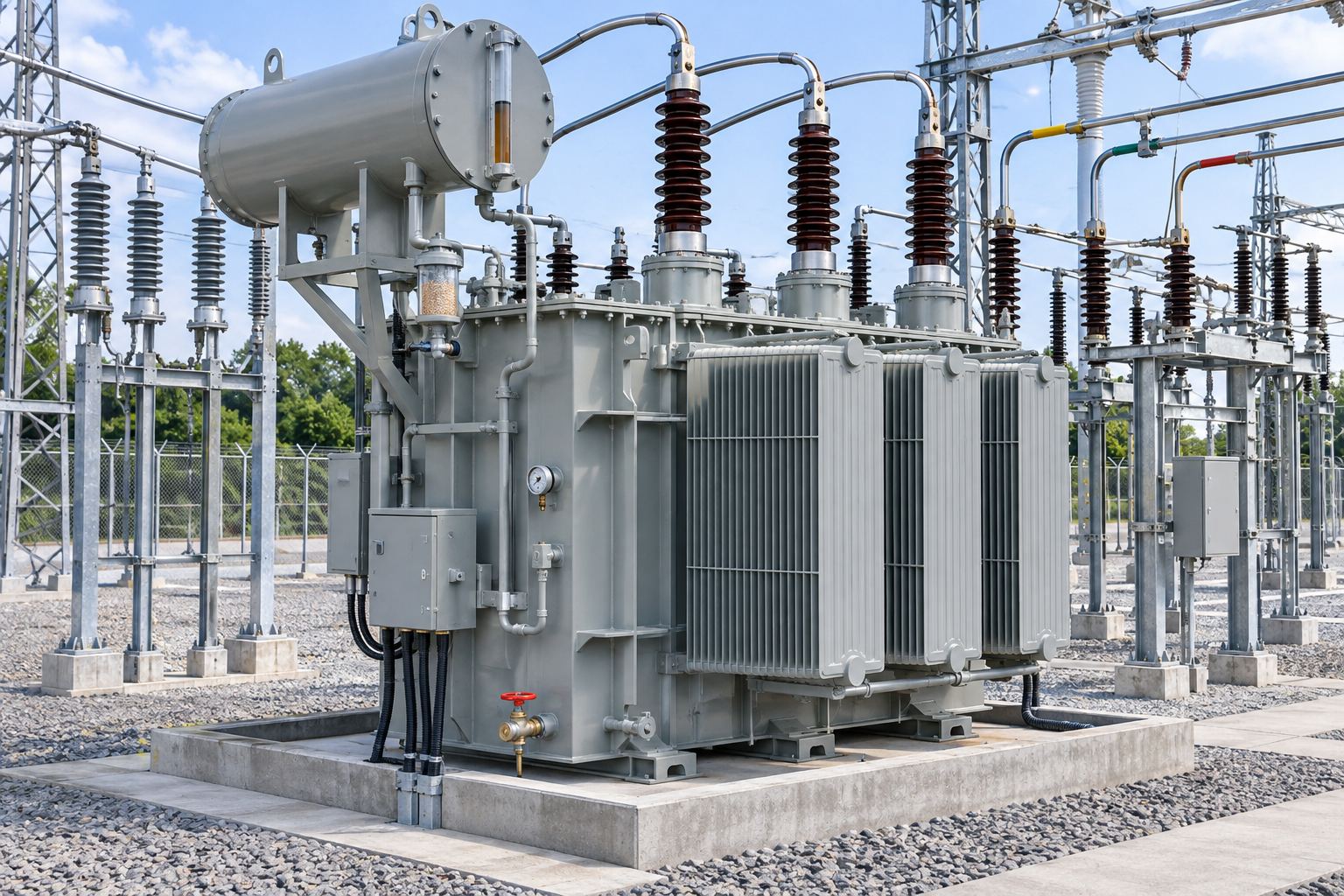
A 35 kV oil-immersed transformer connects utility, industrial and renewable-energy systems across a wide range of capacities. Because each project has different network and site conditions, the factory design should not start from voltage and kVA alone.
Clear technical data at the beginning reduces drawing revisions, protection changes and civil rework. The purchase specification should identify the guaranteed performance and the physical interfaces the supplier must meet.
Electrical Data That Drives the Design
Confirm rated power, frequency, primary and secondary voltage, highest system voltage, insulation level, vector group, neutral arrangement and tap range. The network study should provide the required impedance and short-circuit withstand duty.
Loss evaluation should distinguish no-load loss, load loss, auxiliary consumption and the economic value assigned to each. A low purchase price may not be the lowest lifecycle cost when the transformer is energized continuously.
Mechanical and Accessory Checklist
Define ONAN or ONAF cooling duty, temperature-rise limits and fan-control stages.
Confirm bushing type, terminal orientation, cable boxes or bus connections and phase spacing.
Specify conservator or sealed-tank arrangement, oil-preservation system and pressure protection.
List gauges, alarms, contacts, marshalling cabinet, CTs and online monitoring points.
Provide transport limits, lifting and jacking points, total mass and shipping configuration.
Coordinate foundation loads, oil containment, fire separation, earthing and maintenance clearances.
Approve Documents Before Materials Are Committed
The review package should include a general arrangement, nameplate data, terminal plan, control schematic, accessory list, foundation loads and guaranteed-loss schedule. Comments must be resolved consistently across electrical and civil drawings.
Factory test scope, witness points, report format and spare parts should be agreed before production. This keeps the final inspection focused on requirements that were defined, priced and engineered from the start.
A utility substation upgrade requires more than additional transformer capacity. The equipment must also support stable voltage conversion, predictable maintenance and safe integration with existing protection systems. This application case outlin...
Compare dry-type and oil-immersed transformers by cooling, installation, maintenance, fire safety, efficiency and application before specifying your project.
Microgrids are gaining attention as utilities, communities and industrial sites look for ways to maintain critical services during wider grid disturbances. A June 2026 U.S. Department of Energy article highlights how microgrids can reduce expected...
Underground distribution is growing in cities and new developments, but pole-mounted transformers remain an efficient solution for many rural and low-density networks. They use the existing overhead route, require little ground space and can be in...
 Featured Categories











提交产品咨询
我们将会在24小时内联系您