Artificial intelligence is moving from pilot projects into practical grid operations. The International Energy Agency’s September 2026 report Modernising Grids in the Age of Electricity says digital tools can improve forecasting, optimisation, situational awareness, resilience and risk management across transmission and distribution networks.
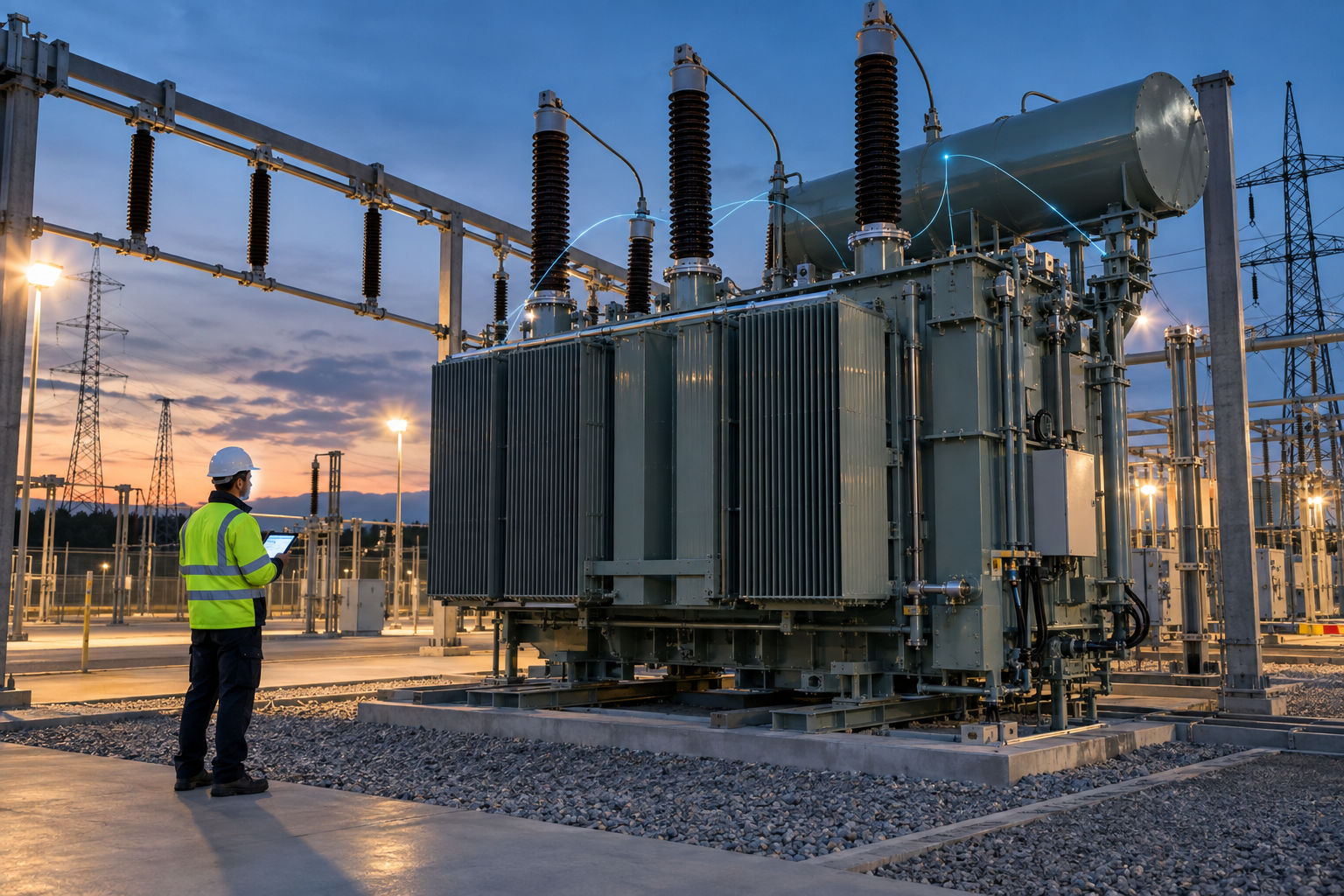
For transformer projects, the important change is not simply adding more sensors. Utilities and industrial operators need monitoring systems that turn temperature, load, cooling and condition data into decisions that protect equipment life while making better use of available capacity.
Why Digital Grid Operations Matter
Electricity networks are carrying more variable renewable generation, battery storage and concentrated loads such as data centres and fast-charging hubs. These conditions create faster changes in loading and power flow than many traditional planning assumptions anticipated. Better visibility helps operators distinguish between a temporary peak, a developing cooling problem and a sustained capacity constraint.
AI-enhanced applications can support load forecasting, anomaly detection and maintenance prioritisation, but their results depend on reliable field data. Transformer monitoring therefore remains the foundation: oil and winding temperature, ambient temperature, load current, cooling-system status, dissolved-gas data where required, and alarms must be accurate and time-synchronised.
Five Requirements to Define Early
Sensor scope: specify the measurements needed for thermal, electrical and mechanical condition assessment instead of adding instruments without a clear operating purpose.
Data quality: define accuracy, sampling interval, time stamping, data retention and rules for missing or abnormal readings.
Communications: agree protocols, interfaces, network architecture and responsibility for integration with SCADA, a historian or an asset-management platform.
Alarm ownership: set warning and trip thresholds, escalation procedures and the person or team responsible for each response.
Cybersecurity: treat connected monitoring equipment as part of the operational-technology environment, with controlled access and maintained firmware.
Monitoring Must Match the Transformer Design
A useful analytics platform cannot compensate for a thermal model that does not match the transformer construction, cooling method or insulation system. Nameplate ratings, temperature-rise limits, impedance, tap range, loss guarantees and cooling stages should be linked to the monitoring configuration during engineering review.
For oil-immersed transformers, projects may also consider oil-level indication, pressure protection, dissolved-gas monitoring and fan or pump status. Dry-type units may require winding-temperature sensors, ventilation status and environmental monitoring for dust, moisture or high ambient temperature. The appropriate package depends on criticality and operating conditions.
From More Data to Better Decisions
The goal is not to collect the largest possible volume of data. It is to detect abnormal behaviour earlier, prioritise maintenance and understand the margin between actual loading and safe operating limits. Projects should begin with a clear decision framework, then select sensors, communications and analytics that support it.
Grid connection queues are becoming a central issue for power-system developers. The International Energy Agency’s Electricity 2026 report says more than 2,500 GW of renewable generation, storage and large-load projects are waiting in connection q...
As a common power distribution management equipment, circuit breaker is indispensable to almost all power consumption areas. As the city continues to upgrade, circuit breakers are constantly updated. With the rise of the Internet of Things a...
AI and data centre growth is increasing electricity demand in 2026. See how transformer capacity, medium-voltage switchgear, protection coordination and flexible distribution planning support reliable power systems.
Compare pad-mounted and pole-mounted transformers by installation, safety, capacity, maintenance and application to choose the right distribution solution.
 Featured Categories










提交产品咨询
我们将会在24小时内联系您