Distribution transformers are essential to new substations, renewable-energy projects, industrial facilities and network replacement programmes. As utilities and developers expand their systems, delivery schedules and component availability have become important parts of technical planning—not simply purchasing details.
Why lead times remain important
The U.S. Department of Energy continues to identify transformers, circuit breakers, substation components and power electronics as equipment affected by supply-chain pressure. In August 2026, the department announced plans for a programme of up to USD 375 million to strengthen manufacturing capacity for critical grid equipment. Although project conditions differ by country, the broader lesson is clear: specifications and sourcing decisions should begin early.
Five points to confirm before ordering
Electrical ratings: capacity, primary and secondary voltage, frequency, vector group, impedance and tapping range.
Installation conditions: indoor or outdoor location, altitude, ambient temperature, enclosure and cooling method.
Efficiency and losses: define applicable standards and project targets before design is finalised.
Certification: confirm whether CE, UL or another market-specific requirement applies to the selected product.
Accessories and documentation: protection devices, monitoring, terminals, drawings, routine test reports and shipping requirements.
Standardisation can reduce project risk
Where site conditions allow, using repeatable voltage classes, accessory packages and connection arrangements can simplify engineering review and spare-parts planning. Clear documentation also reduces approval cycles and helps suppliers confirm material availability earlier.
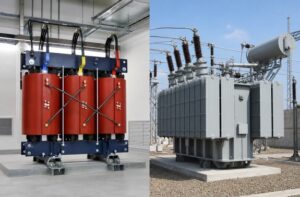
The best transformer choice still depends on the application. Pad-mounted designs suit many underground distribution systems, oil-immersed transformers are widely used for outdoor distribution, and dry-type transformers provide an alternative for selected indoor and infrastructure projects. A complete technical data sheet allows these options to be compared on a consistent basis.
Antes de definir las especificaciones de su proyecto, compare los transformadores de tipo seco y los sumergidos en aceite en cuanto a refrigeración, instalación, mantenimiento, seguridad contra incendios, eficiencia y aplicación.
With the rapid development of photovoltaic technology, perovskite solar cells (PSCs) with high efficiency and low cost have attracted much attention, which have the potential to replace traditional crystalline silicon cells. In particular, flexibl...
The China Charging Alliance released the operation status of the national electric vehicle charging and replacement infrastructure in April 2023. In April 2023, there were 67,000 more public charging piles than in March, with a year-on-year increa...
La demanda mundial de electricidad se está acelerando en el periodo 2026-2027. Descubra por qué la eficiencia de los transformadores, la capacidad de la red, la definición temprana de las especificaciones y la planificación coordinada de los equipos de conmutación son fundamentales para los nuevos proyectos energéticos.
 Categorías destacadas











Enviar una consulta sobre un producto
Nos pondremos en contacto con usted en un plazo de 24 horas.