Choosing between a pad-mounted transformer and a pole-mounted transformer is mainly a distribution-system decision. The right choice depends on whether the network is underground or overhead, the required capacity, public access, site space and the utility’s installation rules.
Pad-Mounted vs Pole-Mounted Transformer: Key Differences
| Selection point |
Pad-mounted transformer |
Pole-mounted transformer |
| Typical network |
Underground primary and secondary cables |
Overhead distribution lines |
| Installation |
Ground level on a prepared concrete pad |
Mounted above ground on a utility pole |
| Common applications |
Residential developments, commercial sites and industrial projects |
Rural feeders, residential areas and local overhead networks |
| Access |
Ground-level service access through a lockable cabinet |
Requires trained personnel and suitable elevated-access equipment |
| Site impact |
Uses ground space and requires cable routing and clearances |
Uses the existing pole line and preserves ground space |
When a Pad-Mounted Transformer Fits Best
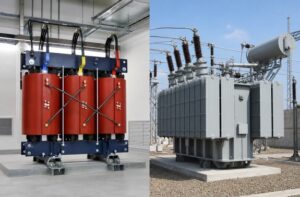
A pad-mounted transformer is usually the natural choice for an underground distribution system. Its enclosed cabinet places high- and low-voltage connections behind lockable doors and gives service teams ground-level access. This arrangement is widely used in residential developments, commercial facilities, renewable-energy projects and industrial sites.
Depending on the network, buyers can consider a single-phase pad-mounted transformer, a three-phase ZGS Series I unit or a ZGS Series II transformer. Final configuration should match the utility’s feed arrangement, protection scheme and cable terminations.
When a Pole-Mounted Transformer Fits Best
Pole-mounted transformers suit overhead distribution networks where service conductors already follow utility poles. They are common for rural electrification, local residential loads and smaller commercial services. The elevated installation reduces the need for a ground pad, but maintenance requires approved lifting and access procedures.
For single-phase overhead networks, see the Overhead D Series single-phase transformer. Capacity, primary voltage, secondary voltage and protective accessories should be confirmed against the actual feeder design.
Transformer Selection Checklist
- Network type: overhead, underground, radial feed or loop feed.
- Electrical ratings: phase, frequency, rated kVA, primary and secondary voltage.
- Insulation level: BIL, clearances, altitude and local environmental conditions.
- Losses and efficiency: compare guaranteed no-load and load losses at the specified rating.
- Protection and accessories: fuses, surge arresters, switches, gauges and cable interfaces.
- Compliance: identify the required IEC, IEEE/ANSI, DOE, CE or UL requirements before quotation.
The U.S. Occupational Safety and Health Administration notes that three-phase pad-mounted transformers are associated with underground primary circuits, while pole-type transformers are used for overhead service. Project specifications and the local utility’s rules remain decisive.
Frequently Asked Questions
Can a pad-mounted transformer replace a pole-mounted transformer?
Yes, but it is not a simple equipment swap. The project may need underground cable, a concrete pad, grounding changes, protection coordination and utility approval.
Which option is better for a public area?
A properly specified pad-mounted transformer provides a lockable enclosure at ground level. Required clearances, barriers and local safety rules must still be followed.
What information is needed for a quotation?
Provide phase, frequency, kVA, primary and secondary voltage, vector group, impedance, installation environment, feed arrangement, accessories, standards and delivery destination.
Need help matching a transformer to your network? Send us the single-line diagram or basic electrical ratings, and our team can recommend a suitable configuration.
Technical references: OSHA Electric Power Glossary; U.S. Department of Energy Distribution Transformers.
 Ausgewählte Kategorien












Produktanfrage senden
Wir werden uns innerhalb von 24 Stunden bei Ihnen melden.